Your future customer isn't looking for you. Yet.
Guide them to your brand with scroll-stopping, lived, customer stories.
.png/:/rs=w:1240,cg:true,m)
One $295 Pilot Project. Dozens of Story Ideas.
1. We represent a large community of American consumers
It's a research panel and we use it to find people who recently changed brands in your product category. We ask them one question.
What were you feeling when you realized you needed to change brands?
We get them to detail what caused the obstacle they faced, how they got into the position, and what was the end result of the brand switch. While not your customers, they're category level users.
Dozens of real stories, from real customers, waiting to be told.
The authentic human language, told by the person who lived the experienced. This is precisely what will land with your future customer.
2. The customer is the hero, you're the Guide.
Most companies make the mistake of being the hero of their own marketing. They make it entirely about themselves. With storytelling, your company's role is never the hero. Instead, you'll be the "Guide".
Your role is to highlight the obstacle the person's faced, to acknowledge their situation, and through empathic language, talk about a better way.
You're not claiming this is your your customer. Your role is to say to the audience, your future customers, if you're out there, we hear you. There is a better way.
3. Provide a path for your future customer to follow.
Every story you share leaves the readers, aka your future customers, thinking a little differently than they did before. All done without selling.
That's what makes one story naturally lead to another. As the storyteller, you can tease them wirth what's coming next. This is how to build an audience.
Stop publishing isolated posts and start building an audience that comes back, not because they're looking for your company, but because they're looking for the next story.
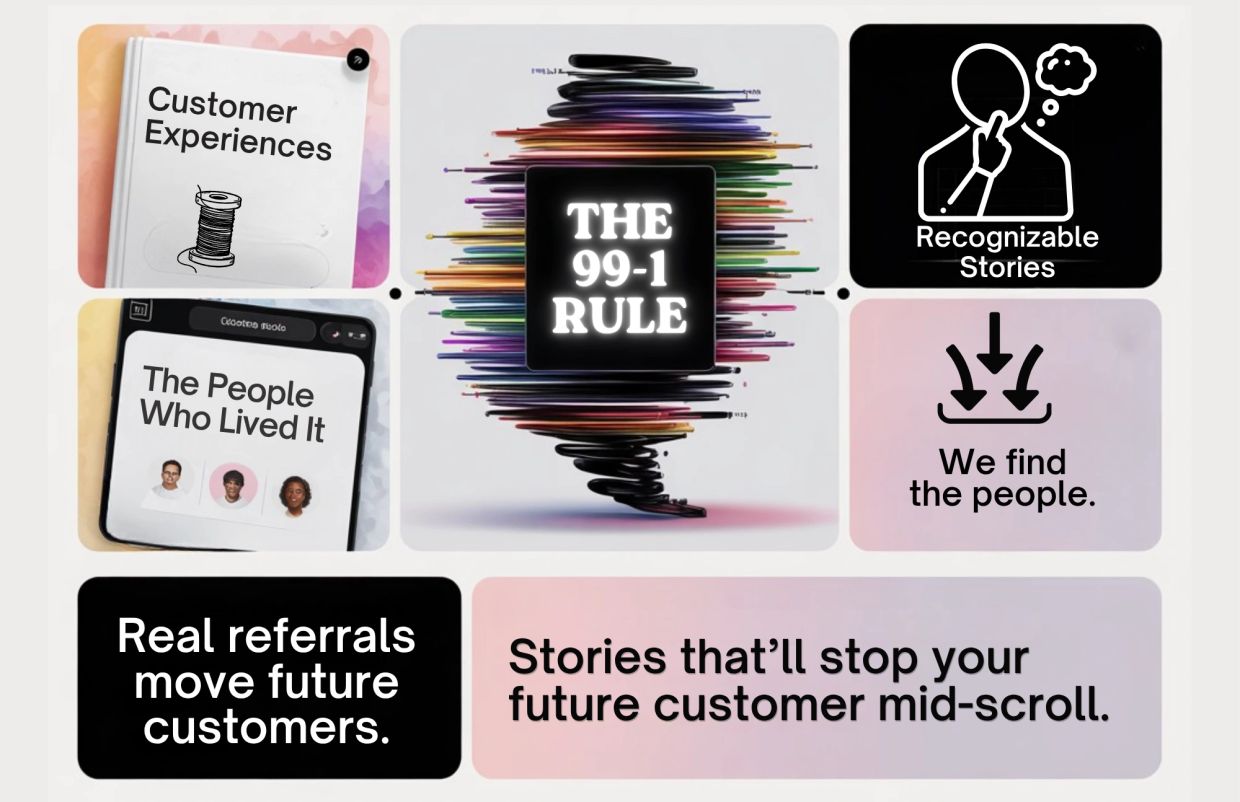
THE 99-1 RULE
The 99-1 Rule is about the disconnect RE how companies sell on LinkedIn.
Here's the 99.
Ninety-nine percent of companies on LinkedIn are marketing the wrong way: pitching themselves to people who didn't come to be pitched. When your future customers are on the platform, they're there for one purpose. To check on the careers of people they know. Who got promoted, who changed jobs, that sort of thing. Trying to sell to them will likely do more harm than good.
Now, here's the 1.
There is one, and only one, reliable way to get their attention. A real story they recognize, one that lands close to home. And getting the attention of the LinkedIn audience is a worthy endeavor. LinkedIn holds the most valuable professional audience anywhere: the decision-makers, the owners, the people who write the checks.
Here's why the 99-1 Rule matters.
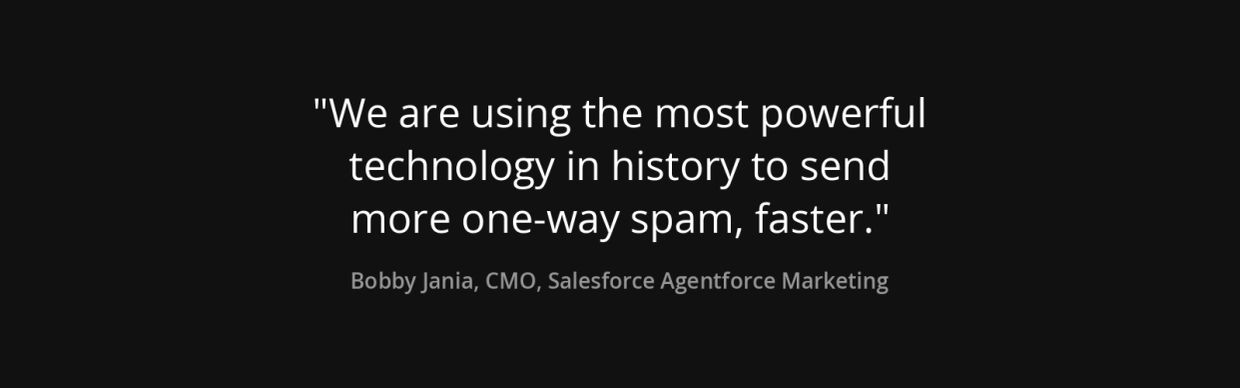
The tipping point for LinkedIn occurred when the sheer volume of the 99 percent became a problem LinkedIn couldn't ignore. Feeds are now flooded with content that people can immediately see is 100% AI generated. Basically its AI-slop. So LinkedIn acted, and its new algorithm reads content for meaning, buries the generic, and rewards real stories told in real customer language. As Salesforce's own Bobby Jania put it: "We are using the most powerful technology in history to send more one-way spam, faster."
The 99-1 Rule used to be advice. Break it, you got ignored.
Now it's law. Ignored was recoverable.
Buried is not.
How the algorithm rewards story publishers.
When your brand posts a real CueVu human story, it doesn't reach your future customer by luck. In the instant before their feed loads, the algorithm runs thousands of calculations about the content and about them: what they've paused on, what they've read to the end. It matches the story to the person most likely to recognize it. Your only job is to feed it something real. By the time they finally go shopping, your brand isn't a name they have to learn. It's already familiar.
Real customers become your referral heroes.
Start with a $295 Referral Pilot Project
One category. One question. Get dozens of customer referrals.
With our $295 Pilot Project, once you see the ROI, then we can schedule a meeting to explore how to build this into a meaningful program for your company to own.
WHAT YOU RECEIVE
The Language File
Think of it as your Referral story library.
The thoughts, phrases, observations, and experiences had just before they decided to switch brands.
Collected from real people.
Ready for LinkedIn, AI, blogs, email, and more. Ready to use.
Or reach us directly at andrew@cuevu.com
Blog
Copyright © 2026 CueVu - All Rights Reserved.
Real Language Wins.